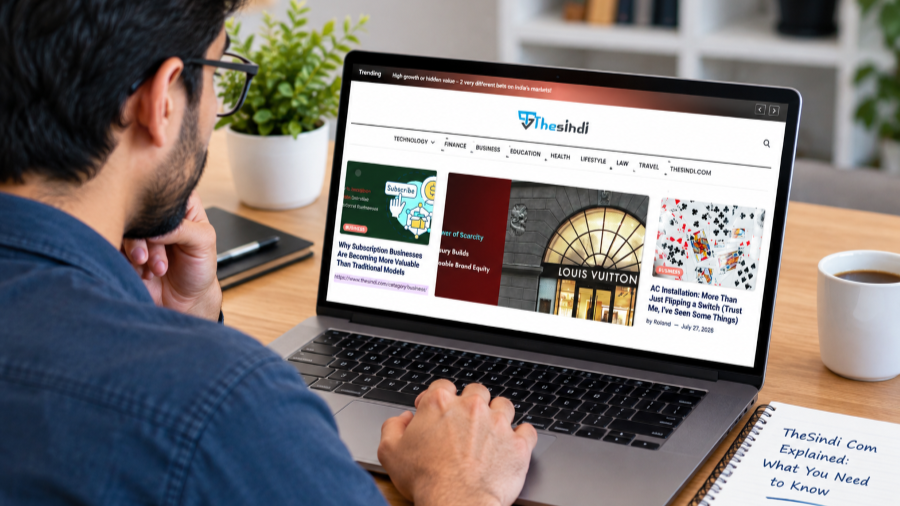
TheSindi com is a general interest publishing website that has been online since 2023, and it now covers technology, finance, business, health, education, lifestyle, law, and travel. People search for the name for a simple reason. They land on one of its articles, or they see the name in a social media post, and they want to know whether the site is real. They also want to know who stands behind it and whether its advice is safe to follow. This guide answers those questions with facts taken from the site itself and from independent reports published in 2026.
Here is the short version up front. The website is real and active, and its homepage feed shows fresh posts as recently as October 2026. The homepage and menu show article categories only, with no apps, downloads, or login portals. The publication also posts its own identity page that warns readers about lookalike domains. On the other hand, it is a broad publication rather than a specialist authority, so readers should double check anything about money, health, or legal matters. The sections below explain each point in detail so you can judge for yourself.
What the Publication Actually Is
TheSindi com describes itself as an independent digital publication. Its official identity page states that it was founded in 2023 and that its goal is to publish informative, reader focused articles and guides. Third party domain reports agree with that timeline and list the domain registration date as March 18, 2023. The monthly archive pages on the site run without a gap from May 2023 through October 2026, which shows that the publication has kept posting for more than three years. That track record separates it from the many short lived blogs that appear for a few months and then go quiet.
Quick Facts at a Glance
A small table makes the basics easier to scan. The facts below come from the site itself, including its homepage, its menu, and its official identity page. Items that come from independent reviewers are marked as such in the later sections. Use the table as a starting point, then read the sections that matter most to your decision.
| Detail | What the site shows |
| Website type | Independent digital publication that runs on WordPress |
| Founded | 2023, according to the site’s own identity page |
| Main menu categories | Technology with a Gaming subcategory, Finance, Business, Education, Health, Lifestyle, Law, and Travel |
| Extra topics named on the identity page | Home improvement and real estate |
| Archive depth | The homepage feed runs for 61 pages, with monthly archives from May 2023 to October 2026 |
| Published policies | Privacy Policy, Editorial Policy, DMCA Policy, Terms and Conditions, Disclaimer, and Contact Us |
| Social profiles | Facebook, X, and LinkedIn |
| Official address | The exact brand name followed by dot com, with no added words or symbols |
What Topics the Site Covers
The publication works like a digital magazine with a wide menu. A reader can move from a story about corporate bonds to a guide about contractor insurance in a few clicks. The categories below match the main navigation bar on the homepage. Recent headlines show that the writers lean toward practical explainers, current business themes, and questions that people type into search engines.
Technology and Gaming
Technology is the first item in the menu, and it holds the most forward looking material. Recent headlines include AI governance, synthetic data as a fix for AI training problems, the GPU economy, and a guide on using AI as a recruiter. The Gaming subcategory sits under Technology, and a recent post in it asks whether investors should back the online casino industry. These articles read as general commentary for curious readers rather than lab tested product reviews. Anyone who needs deep technical detail should treat them as an introduction and then move on to vendor documentation.
Finance and Business
Finance and business form the busiest part of the homepage. Headlines cover venture debt, corporate bond markets, a ten year share price forecast for an Indian finance company, and two different bets on the Indian stock market. Business posts look at luxury brands and exclusivity, subscription models, and the consulting firm Bain and Company. A practical finance post explains how homeowners can verify a contractor’s insurance before signing a contract. Because money decisions carry real risk, readers should confirm any number or forecast with official filings or a licensed advisor.
Health, Law, and Education
Health and law posts tend to answer a single question in plain words. One health article explains how inpatient and outpatient rehab programs differ, and one law article asks whether arrest records are public. Another law article explains how Ontario treats an end of life vehicle as a regulated materials stream before it becomes scrap. Education sits in the menu as well and aims at learning resources and career information. None of these pieces replaces a doctor, a lawyer, or a school counselor, and the site’s own disclaimer page makes a similar point.
Lifestyle, Travel, and Marketing
Lifestyle and travel complete the menu and aim at everyday readers who want ideas and simple guides. The homepage also shows a Digital Marketing category, with a recent post about measuring billboard advertising without click through data. That mix explains why the site appeals to students, small business owners, and casual browsers at the same time. It also explains why the publication cannot match a niche outlet that focuses on one field and hires credentialed experts for it.

Who Runs the Publication
Every article visible on the homepage carries the byline Roland. Independent reviewers who read the About page report that it names Roland Miller as the author and admin and describes him as an SEO specialist, copywriter, and content strategist. The site links to social profiles on Facebook, X, and LinkedIn, and it lists a contact email on its contact page. One reviewer also noticed that the author archive address uses a different internal username than the displayed name, which is a common leftover from early WordPress setups. That detail is minor, but careful readers like to know about it.
Editorial Policy and AI Use
The site publishes an Editorial Policy, and a reviewer who read it reports that the team uses AI tools to support research and efficiency while humans make the editorial decisions. That level of disclosure is more open than many competing blogs offer. At the same time, none of the finance, health, or law posts on the homepage carry a byline from a licensed professional. For general explainers that is normal, but readers who plan to act on medical, legal, or investment content should look for a specialist source as well.
Design, Navigation, and Reader Experience
The homepage follows a familiar magazine pattern. A trending bar sits at the top, followed by a clean category menu and a search icon. Below that, a grid of featured posts leads to category blocks, and numbered pages let readers dig into older articles. The sidebar lists recent posts and monthly archives, and the footer links to every policy page. A banner for a guest post marketplace appears in the sidebar, which tells readers that the site welcomes outside content and earns some revenue from promotion. Reviewers describe the layout as clean and mobile friendly, but page speed varies by device and connection, so test it on your own phone.
Is the Site Safe and Legitimate?
Domain and Technical Signals
One independent audit reports that TheSindi com runs on HTTPS behind Cloudflare and that checks through Google Safe Browsing and VirusTotal found no malware or phishing flags. The same audit notes that the domain owner details are hidden by privacy protection, which is common and legal. Security results can change at any time, so readers should run their own check before they enter personal data on any website. A simple rule helps here. A content blog never needs your password, your phone number, or a one time code.
Rumors About Free Tools
Some social media posts claim that the site offers secret tools such as free WiFi access, Instagram account recovery, or call tracking. The homepage and menu show nothing of the kind. They list article categories, policy pages, and social links, and they show no app, no download, and no login portal. No blog page can unlock a router it does not control, and no third party site can recover your Instagram account. If you are locked out, use the official Forgot password and Get help logging in options inside Instagram, and never type your credentials or a security code into a page that promises a shortcut.
Lookalike and Copycat Domains
The publication has posted an official identity statement that warns about lookalike addresses. It names two examples of unofficial variations. One adds a hyphen to the brand name, and the other repeats the word the twice at the start. The page explains that a website which uses the brand name in its title or description does not become the official source by doing so. That warning matters because many unrelated sites now write articles about the same keyword, and some of them copy each other’s wording.
To confirm that you are on the genuine site, check the address bar first. The official domain is the exact brand name followed by dot com, with no extra words, no hyphens, and no strange endings. Next, look for the About page, the Contact page, the Privacy Policy, the Disclaimer, the Terms and Conditions, and the Editorial Policy. A genuine publication shows all of them in the footer, and the branding stays consistent across its social profiles. If any of those pieces is missing, close the tab and search again.
Strengths and Limits
What the Site Does Well
The publication earns credit for transparency and consistency. It posts regularly, names its author, publishes its policies, and warns readers about impersonation. Its writing uses short paragraphs, clear headings, and plain words, so a reader can skim an article on a phone and still catch the main point. Topics track current events, which keeps the feed from looking stale. Those habits put it ahead of the typical content farm that hides its authors and skips its policy pages.
Where Readers Should Be Careful
Independent reviewers point to thin sourcing as the main weakness. Claims often appear without links to the studies, filings, or official data behind them. Depth also varies from one category to another, and some pieces read as commentary rather than original reporting. Reviewers further note a heavy use of generic stock photos instead of original charts or screenshots. These limits do not make the site unsafe. They simply mean that readers should treat it as a starting point and not as a final authority.
How It Compares With Other Publishers
The table below places the publication between a specialist outlet and a low effort content farm. It uses the facts gathered in this guide plus the reviewer observations noted above. The comparison is meant to help you decide how much weight to give a single article. It is not a ranking of quality.
| Factor | This publication | Specialist outlet | Typical content farm |
| Topic breadth | Very wide, eight or more categories | One narrow field | Wide, often wider |
| Named author | Yes, byline Roland | Yes, often with credentials | Rarely |
| Visible expert credentials | Not seen on health, finance, or law posts | Common | Almost never |
| Policy pages | Yes, six published | Yes | Often missing |
| Best use | Quick orientation on a topic | Decisions about money, health, or law | Not recommended |
How to Check Any Article Before You Trust It
A quick routine takes less than one minute and works on this publication as well as on any other general interest site. The routine rests on three habits, and each one targets a common weakness in broad content sites. Readers who build these habits protect themselves from errors, outdated numbers, and copycat pages. The steps below follow the order most people find easiest.
Check the Byline and the Date
Start with the author name and the publish date near the title. Finance, technology, and health topics change fast, so a post that is two years old may no longer be accurate. If an article offers no author and no date, treat it with extra caution. Where a date is shown, compare it with the current year before you act on any figure or forecast.
Look for Primary Sources
Next, scan the article for references to official reports, court records, government data, or company filings. A strong post tells you where its numbers came from. When the text states a statistic without a source, search for that figure on an official website. If you cannot find it, do not repeat it to other people.
Cross Check High Stakes Claims
Finally, verify anything that touches your money, your health, or your legal rights with a specialist or an official body. For health, that means a licensed clinician or a public health agency. For investing, it means regulator filings or a registered advisor. For legal questions, it means the relevant court, agency, or a licensed attorney in your region.
Who Should Use the Site
The publication suits readers who want a plain language explanation of a general topic in a few minutes. Students can use it to get oriented before they open more advanced sources. Small business owners can scan its business and marketing posts for ideas. Casual readers can browse several categories without needing an account, and the homepage shows no paywall or sign up wall. People who need clinical, legal, or investment guidance should use it only as background reading and then confirm the details elsewhere.
Frequently Asked Questions
What is TheSindi com?
TheSindi com is an independent digital publication that was founded in 2023. It publishes articles and guides on technology, finance, business, health, education, lifestyle, law, travel, and related topics. The site is free to read and shows no login portal on its homepage. It works like a digital magazine rather than a news wire or a shopping site.
Is the website real or a scam?
The website is real and active, and its homepage feed shows posts from October 2026. It publishes its policies, names its author, and links to public social profiles. Independent audits found no malware or phishing flags at the time they were run. Readers should still avoid entering personal data on any page and should confirm the domain spelling every time.
Who owns or writes for the site?
Every article on the homepage carries the byline Roland. Reviewers who read the About page say it names Roland Miller as author and admin. The site does not publish detailed company registration information, so readers who need formal ownership details should use the contact page. The domain owner details are also hidden behind privacy protection.
Does the site offer free WiFi, Instagram recovery, or call tracking?
No. The homepage and menu show only article categories, policy pages, and social links. Social media rumors about secret tools do not match what the site displays. For a locked Instagram account, use the official recovery options inside Instagram and never share your password or security code with a third party.
What are the fake or lookalike versions of the domain?
The official identity page names a version that adds a hyphen and a version that repeats the word the. It also states that any similar spelling is unofficial unless the publication confirms it. The safest habit is to type the exact brand name followed by dot com yourself. Bookmark the genuine homepage after you confirm it.
Can I rely on its finance, health, or legal articles?
Treat those articles as general background reading. Reviewers report inconsistent sourcing, and the homepage shows no byline from a licensed professional on these topics. Before you invest money, change a treatment, or sign a legal document, check the facts with an official or specialist source. The site’s own disclaimer page supports that cautious approach.
Does the site use AI to write its articles?
A reviewer who read the Editorial Policy reports that the team uses AI tools to support research and efficiency, with human staff making the editorial decisions. This kind of disclosure is still rare among general interest blogs. Readers who care about the issue can read the policy page directly and judge it for themselves.
Is the site mobile friendly and free to use?
Reviewers describe the layout as clean and mobile friendly, and the site charges nothing to read. The homepage shows no subscription wall and no account requirement. Advertising and a guest post marketplace banner appear in the sidebar. Because speed depends on your connection and device, open a few articles on your phone to see how they feel.
Does the site accept guest posts?
The sidebar carries a banner for a guest post marketplace, which suggests that outside content is part of its model. The site does not describe a submission process on its homepage. Writers who want to contribute should use the contact page and read the Editorial Policy first. Brands should also check that any placement matches the site’s stated standards.
Final Thoughts
TheSindi com is a genuine and actively maintained general interest publication, and it is more open about its identity than many sites of its size. It names its author, posts its policies, keeps a deep archive, and even warns readers about copycat domains. It is not a specialist authority, and it does not show expert credentials on sensitive topics. The best way to use it is simple. Read it for quick orientation, confirm the domain every time you visit, and verify important facts with an official or professional source before you act.